Showing posts with label Design. Show all posts

Friday, June 12, 2020

Journey to Cheeseland Part 5: Randomzing & Customizing Story


Story is about conflict, Without it there is no story. Without conflict there is also no game. Conflict is an obstacle (or series of obstacles) in a character’s/player’s path that must be overcome to reach the ultimate goal. The conflict can either be established through limitations (a player can’t just exit a room, she must overcome enemies, solve a puzzle or perform some other dastardly task first) or by having players compete against each other. 

Let me be clear, “Journey to Cheeseland” isn’t a “story” game. It’s a cat & mouse board game with story elements but because of my narrative design background I wanted to maximize these elements to make the game feel like an adventure and create a new experience each time players venture out onto the board. 


In this serie’s first blog (https://pixeldoriangm.blogspot.com/2020/05/journey-to-cheeseland-beginnings.html) I mention that story is much more than cutscenes and lengthy (sometimes interactive) dialogue sequences. It can be told through elements like your board, items, tokens etc. as well as the type of conflict you face and the goal you are trying to achieve. In this blog I will focus on randomizing and customizing key story elements to create a more unique experience within an established “frame” or world. 


World Creation: Telling a story requires defining the world and the time in which the story takes place. This can range from a realistic world to a fantasy setting. “Journey to Cheeseland” transports players into a current day city in which mice have human level intelligence but are driven by mice instincts and desires (at least themed as such even if not real). The city is experienced from their perspective and point-of-view. Humans only exist on the periphery and are generally to be avoided (except for the all-knowing librarian and a friendly street musician). Were it a cartoon humans would only be seen from their waist down (like in the classic Tom and Jerry movies) and their words would sound like the trumpet woap woap noises the teacher makes in “Charlie Brown.”


My primary goal was to make the players feel like the heroes of the story. In the initial concept of Cheeseland players were competing against each other to reach the magical Cheeseland. But such a selfish goal didn’t feel heroic. So I added a mystery (the disappearing cheeses) and a reason for the mice to work together, finding Cheeseland while the city’s inhabitants suffer from cheese withdrawal. I also gave the mouse heroes a rudimentary knowledge of technology (mostly gathered from scavenging items from scrap yards and trying to put them together) and the use of old-fashioned walkie-talkies to communicate and plot together. This sets them apart from the city’s other mice who see technology as something alien and most likely, not to be trusted.


Randomizing Story: The background of the disappearing cheeses is part of the “embedded” story, meaning that each session has the same starting point and overarching goal. Though the objective in what would be  referred to as a “gather quest” in role-playing games is always the same I wanted to randomize some of the components to mix things up. Yes, yes, in an ideal world I would also randomize the setting and the goal but that would have been too complex for this game’s requirements (remember when I mentioned that one of the requirements was to keep this game simple). It could easily become part of expansion packs though, using the same board and mechanics but with a new set of cards and it’s something I’m definitely considering (so be forewarned of more to come!). 


So I started with identifying elements I could “easily” randomize:


Clue Givers: Each game starts with a different set of Clue Givers, some eager to help, some not so much. Note that convincing each of these Clue Givers to help is optional. It’s just the most efficient way to collect clues. 


The Cheeses: The last five cheeses and their location are also randomized during the setup. As with the Clue Givers the difficulty level of these cards varies with the Blue Cheese being the easiest to “sniff out” and the Mysterious Cheese X only found on the black market the hardest to track down.


The Secret Entrance to Cheeseland: This randomized location is only revealed once all the cheeses are tracked down. It is the only way to access Cheeseland and confront the mastermind. 

These elements don’t change the overall story but they change the key destinations on the board and vary the encounters you have. 


The Mastermind: This may be the most important randomized element as it affects the story’s final scene. I’ll get more into this in the section about branching narrative.

There are two reasons why I didn’t randomize more of the starting elements:
  1. Card count. I’m currently designing this as a print-at-home game. Adding more cards adds more pages to print and more cards to cut and glue together. Even if eventually published as a boxed game a higher card count adds to the printing cost. 
  2. Board layout. The randomized cards are currently laid out as follows:


Adding more random elements would require more space on the board and more setup time.

Encounters: The main random story element of the game are the encounter cards drawn every time a mouse rolls a 1 or 2 while moving. These encounters range from humorous to dangerous. You never know what is waiting for you around the next corner.

Items: Randomized items found by the player may only tell a micro-story (hey, I found a cool stinky fish) but have a real game impact as many of them can be used to the player’s advantage (not the stinky fish though) and in turn create a new story moment (I used Duke, the dog, to chase Maxo away!).

It’s your Story, Morninglory! 
Taking a cue from role-playing games narratives in many other genres have evolved from the linear “let me tell you a story” to the more interactive and customized “tell your own story.” Branching stories (making choices and experiencing the consequences of those choices) and customization (creating your player character, defining elements of the world etc.) gives players a way to express themselves. I decided to borrow some of the elements of this narrative evolution in Cheeseland.

Making Decisions: I wanted to give players the option to make a decision beyond the expected tactical choices (where do I go next, which goal should I tackle first etc.). I added these kind of decision points in the encounter cards. 


My current thought on encounter cards is to have players hand them over to either Maxo or another player to read aloud. This gives each reader a storyteller moment as they share what happens to the active player and wait for her to react to it.

The main decision will have to be made by the mice when confronting the Mastermind at the end of the game (assuming Maxo doesn’t stop them first). 

Some of them were designed to be plain silly ...


..others have a more of a classical villain flair with some dicey options (see what I did there?).


So though each journey has the same beginning, its middle and end will differ each time.

Customization: This is another role-playing element I wanted to introduce. It starts with each player being able to choose a character with a unique “power.” Even though limited, these “powers” help each player feel unique and encourage collaboration.


(Player card wip)

Filling in the blanks is another way for players to customize their story. The most obvious “fill-in-the-blanks” is each character’s bio but I introduced other instances on the cards for players to create their own story moment. Sure, these moments are purely for flavor (they don’t affect the game itself) but players have fun coming up with reasons why they got themselves in trouble or have an opportunity to yell out their favorite superhero’s name. 


My final story task is to explore options for players to create their own encounters or Mastermind using some preexisting format to avoid unbalancing the game. We'll see how that goes.

Whatever game you’re working on it’s worth taking some time to explore these types of narrative devices. If done right it can make the game more immersive and memorable. So think about it as you introduce your game’s story.

My next blog will be about prototyping, something I strongly recommend even for electronic games. 

Have fun with the new exercise. If you enjoy this series and the games I'm developing you can support my work at https://ko-fi.com/pixeldorian. Thanks for sharing and see you soon!

Exercise
Take two different types of games like “Pandemic” (yeah, I know) and “Mousetrap” (!) or “Cards against Humanity” and “Checkers.”
  • What is the conflict in these games? If there doesn’t seem to be a story is there a theme that could be turned into a story? 
  • How do the conflict in both games compare?

Wednesday, May 13, 2020

Journey to Cheeseland Part 3: Designing the Key Mechanics


Welcome back to my designer notes about the board game “Journey to Cheeseland.” For those who just joined me you can check out the first part of this series here: Journey to Cheeseland: Beginnings

Today I’ll talk about designing some of the key mechanics for the game.


Game mechanics are defined by the ways players can interact with the various game elements (in the case of a board game the board and various pieces) and how these actions affect the game state. Or more simply put: What can players do? How do they do it? What happens when they do it? 
The most important question that defines the potential actions is: What is the players’ ultimate goal? 

So what is the main goal in Cheeseland? Originally it was simply finding the secret entrance to Cheeseland. The first player to make it to Cheeseland won. But as the story evolved it became more about solving the mystery of the disappearing cheeses and confronting the evil mastermind behind it. As mentioned in the first blog I also changed the gameplay to a cooperative gameplay instead of a race to the final destination. In the new version finding and entering Cheeseland is a requirement to confront the evil mastermind and return the stolen cheeses to Grand Central. Although I introduced a clear “lose” state for the mice with Maxo’s track (Maxo wins the game if he manages to move his token all the way to the end of the track before the mice make it to Cheeseland) I decided to leave the “win” state a little more story driven and open ended. By entering Cheeseland and confronting the evil mastermind the mice put an end to the disappearance of the cheeses but the final choice players make and the outcome of the final confrontation changes the ending to their heroic journey.

First of all I made the evil mastermind a random card the player places on Cheeseland and uncovers at the end. I’ll talk more about randomness introduced through various cards in another blog, but its purpose is to add discovery and replayability. If the adventure changes every time you play it’s obviously more fun. Not all evil masterminds are technically evil. Some of their motives for hoarding all the cheeses are either misguided or just silly. Players get to choose from two different options when exposing the mastermind and then roll for the final outcome. So a game may end with exposing the evil mastermind but him getting away or you actually going along with his crazy scheme, something that is very RPG inspired. You may not always get the perfect outcome you were looking for but you get at least the partial satisfaction of having solved the mystery and put an end to the disappearing cheeses.

Games often have intermediate goals that need to be achieved first. In video games these are often levels players have to complete in a sequential order but intermediate goals can also be conceived in a less linear fashion (although there may be a strategic advantage to doing them in a certain order). Either way these milestones give a sense of progression. In Cheeseland the goals are visually represented by cards turned face down and five tracker tokens that need to be placed. The players must reveal all the cards in order to win the game. Specifically these cards (selected randomly at the start of each game) are:
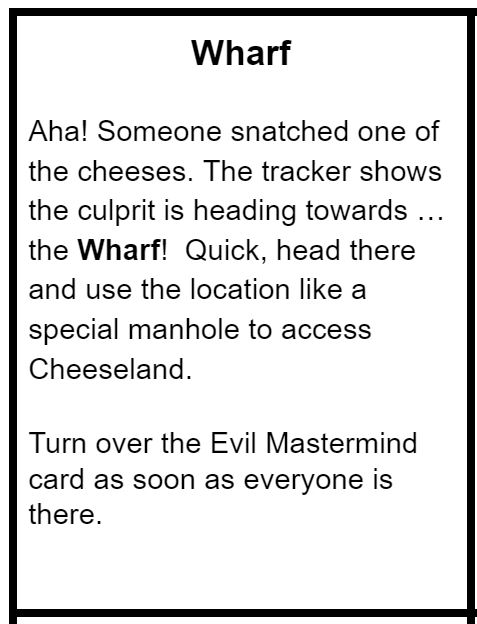
Five Cheese cards: These represent the only remaining cheeses in Grand City. Players need three clues in order to turn over each card (the order is up to them). Doing so will reveal the location of a particular cheese. Once a cheese location is known the mice can head there to find the cheese and place a tracker on it.  Note that collecting clues and tracking the cheeses can be done in parallel as soon as at least one of the cheese cards is revealed.
Secret Entrance to Cheeseland card: This card can only be revealed once all cheeses have been found and a tracker was placed on them.
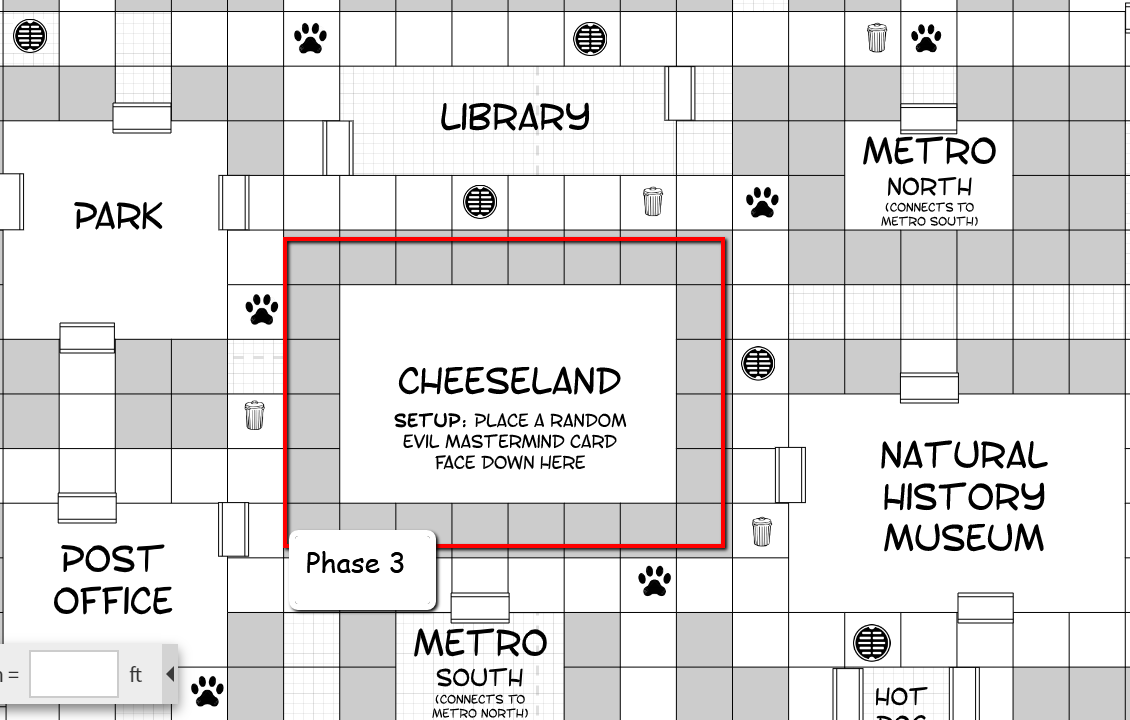
Evil Mastermind card: This card can only be revealed once all mice made it to Cheeseland. It will outline the final confrontation.
  
Here is how this flow is currently laid out on the board:

Here’s a sample Cheese card once revealed:

And a sample location card revealed after all the cheeses are found.

This leads to the final confrontation in the center of the board.

Note that I added setup instructions directly on the board (though I will distinguish them better in the final version). My goal is to have as much information as possible in front of the players (board and cards) instead of forcing them to constantly refer to the manual. 

You may have also noted that I try to convey story elements through the cards by adding flavor text (like with the cheeses) or the way instructions are conveyed (like with location card).

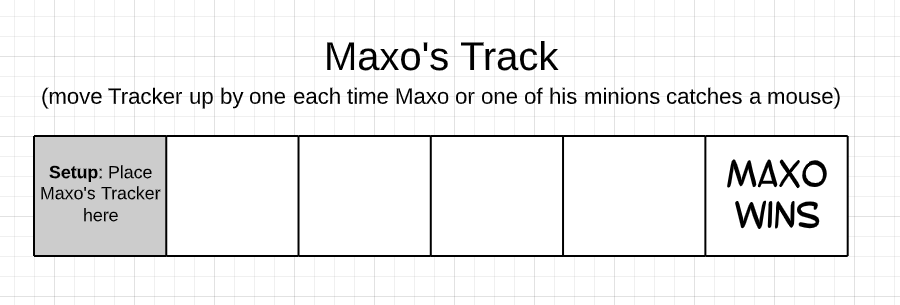
Maxo’s goal is to interfere with the mice as much as possible and he scores points by catching them. His goal is visualized by a track.
Note that the final length of the track may vary after playtesting.

Taking Action: So what are the actions players can take to achieve their goals? The game is themed as a cat and mouse game so I based the initial actions on what cats and mice can do. Being a cat Maxo and his goal being to interfere with the mice he can move and pounce. To make him more effective he can also recruit and move minions. Note that giving him this “special” ability defines the world of Cheeseland and requires some thought as to what cats and mice are like in this setting. 

The mice are trying to evade Maxo and his minions while finding the secret entrance to Cheeseland. As mice some of the obvious actions are: move, hide and evade. Just like Maxo though they are smarter and more resourceful than their real-life counterparts. Here too defining how smart and resourceful they are defines the world. I mentioned giving Maxo the ability to recruit and move minions to make him more powerful (a gameplay decision). This worked from a narrative standpoint as I knew that I wanted to give the mice similar “unrealistic” abilities. I could have given them human-like abilities and intelligence with actions like crafting gadgets or flying airplanes. I could also have turned this into a magical world with the ability to cast spells and whatnot. But I wanted to stick with the theme of tiny mice having to confront a large and dangerous city. I wanted the dangers and obstacles to be inspired by real dangers a mouse would face like traps, poison, traffic and of course, cats. I envisioned more of a Tom and Jerry kind of world than for example Mouseguard. Though obviously enhanced the abilities should remain limited. So here is the current list:

Move: The players roll a dice to move their mouse token on the board. The total can be affected by items spent or conditions the mouse may be suffering from.

Hide: This is a preventive action a mouse player can take to increase its chances to evade Maxo or one of his minions. 

Evade Maxo and his Minions: This action is automatically triggered when Maxo or one of his Minions launch a pounce attack. Instead of giving the Maxo player a static number to beat I preferred giving the mouse player an active chance to escape by having both roll against each other. Some factors like hiding mentioned above or spending some items can affect the outcome of the roll.

Search:  Mice can search the streets for clues. What they find is randomized. 

Interact with various citizens of Grand Central: Humans are mostly off-limit (I made two exceptions for the Clue Givers though here too took more of a Tom and Jerry approach where humans are only seen from the animal’s perspective). The type of interaction is defined by the Encounter and the Clue Giver cards. The Encounter cards usually give a couple of options to choose from and then require to roll for the outcome. The Clue Giver cards give the option to try to convince one of the inhabitants to give you clues about the whereabouts of the last five cheeses. Here the action is defined as a “convince” action and the outcome dependent on a roll.

Resolve Encounters: I mentioned that I wanted the obstacles to be inspired by real dangers like poison, traps and traffic. These random encounters are also resolved with a dice roll and usually have a binary success/failure outcome.  

Use the Walkie-Talkie: This is the most blatantly unrealistic action for mice but it fills an important role I mentioned in my first blog: co-operation. Besides providing a logical explanation for the mice’s ability to communicate and strategize, the walkie talkie is also used as a way for players to help each other by using their action to add their roll to another mouse’s roll. I’ll go into more details about the use of the walkie-talkie to enhance cooperation in another blog.

I briefly considered giving the mice some high-tech devices to introduce more of a “Mission Impossible” feel but much prefer the simpler retro feel of the walkie-talkies. From a narrative standpoint I imagined the mice scrounging up parts from a scrapyard to put together these simple (yet still effective) devices. (Purely narrative background, not an activity in the game though it opens the door to one for sequels of the game). This introduces the notion that mice have at least some very basic technological skills which also justifies the existence of trackers and gives me some options for the final confrontation with the evil mastermind.

You may have noticed that most actions are resolved through dice rolls. I’ll talk about the role of randomness, chance and strategy in the next blog but know that this was a conscious decision balanced with the players’ ability to strategize and improve their odds. 

Exercise 3:
Take some of your favorite games and look at the actions players can take and each game’s end goal. Do the goals have anything in common? Can you think of a different goal for one of these games while keeping the same actions?

Share your thoughts on this exercise and if you enjoy this series you can support my work at https://ko-fi.com/pixeldorianSee you soon and stay safe in the meantime.

Tuesday, May 5, 2020

Journey to Cheeseland Part 2: Designing the City/Board

Designing Grand Central


Welcome back to my designer notes where I share some of my process while developing the boardgame “Journey to Cheeseland.” For those who just joined me you can check out the first part of the blog here: Journey to Cheeseland: Beginnings


Creating the board for “Journey to Cheeseland” also meant designing the city in which the game takes place by choosing the type of locations players would be able to explore as well as the overall location of these spots within the city.


Though the game mechanics are very different the look and feel for the board was inspired by “Clue” one of my favorite games as a kid. For those unfamiliar with the game you can check out the rules here: https://www.ultraboardgames.com/clue/game-rules.php


I loved walking around a large mansion while trying to solve a murder. Here’s what the mansion in Clue looks like.


For Cheeseland I wanted to create the feeling of adventuring through a large city while exploring different areas in order to find the secret entrance to Cheeseland and confront the evil mastermind behind the disappearance of the cheeses. I used the same concept of different starting points for each character (though I let each character choose their starting point) and a variety of locations to explore. In this case buildings or city areas like the wharf instead of rooms. These areas are connected by paths the mice have to travel through in order to reach their next destination. Players roll a dice to determine how far they can travel each turn though some items, handicaps or abilities can affect the final number.


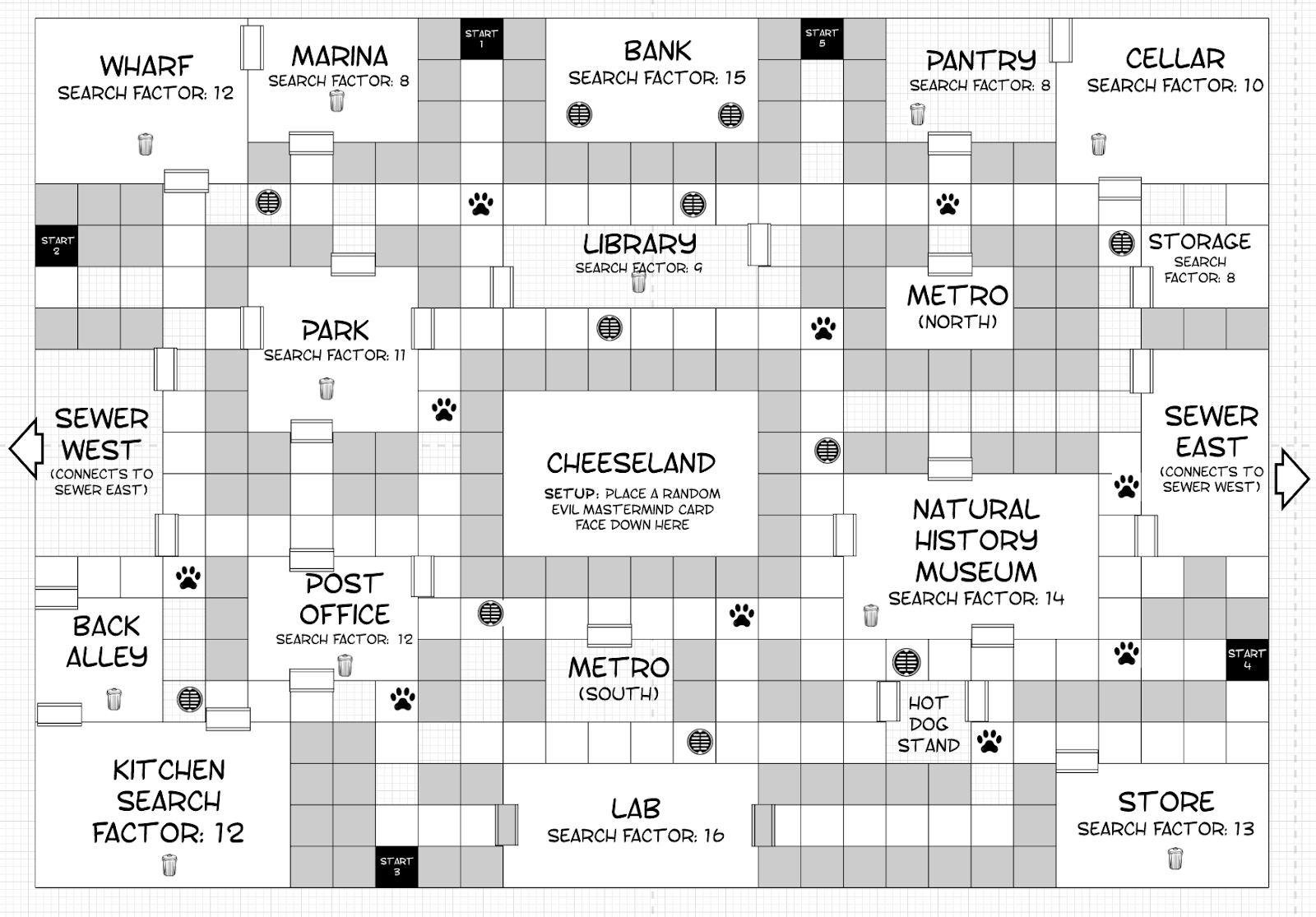
Here’s the current version of the board created in Lucidchart.


You may notice that each starting square is more than six squares away from any location or manhole. 


That’s to avoid mice being able to reach a location on their first turn. No matter what, they have to face danger as soon as they leave their starting point. On average they will be able to do so on their second turn (okay, slightly lower than average since it takes 7 or more to reach the nearest location).


Even though I wanted to recreate some of the fun of exploring a map I experienced in clue there were some key differences I had to consider during the layout.


Connecting paths: One of the major differences are the paths on which players travel. In Clue areas between rooms are wider than one square because they only exist to delay you. In Cheeseland these areas are actually the “danger zones” as you may have to face dangerous encounters and Maxo and his minions are always trying to pounce on you. So I designed narrow “corridors” the mice have to travel through to create more tension while they’re being chased. 


Shortcuts: Clue has secret passages you can use to travel from one room to another. Instead I used the concept of manholes that allow mice to resurface in a different area of the city. Only one room, the bank, can be accessed directly through a manhole. It’s actually the only way to enter the bank. Using these manholes doesn’t just save time, it’s a crucial way of escaping Maxo and his minions as they can’t follow you though they can block manholes by sitting on them. From Maxo’s perspective manholes create a whack-a-mole mechanic as he keeps trying to catch the mice before they disappear into the next hole.


Number of locations: Having a variety of locations was important to create more of a city feel and support the “journey” theme. Since mice are also in danger while on the streets these locations offer safe spots for them. And yes, I added a library and post office because they are important, dang it!


Other things you may notice on the board are paw prints. These are starting locations for Maxo’s minions. Each round the cat player can either move Maxo (special token with double move options) or one of the minions to try to pounce on a mouse or pursue it. 


I’ll go into the trash icons in more detail when I talk about the mouse actions but basically mice have the ability to dispose of trash icons in these locations and receive a reroll token in exchange. 


Role of Streets: As mentioned streets are dangerous. Not only are Maxo and his minions out on the streets but when a mouse rolls a 1 or 2 on its movement roll it must draw an encounter card. Not all are bad but well, many are. When a mouse lands on a street square it can also search the street for potential clues as one of its actions. A search roll determines if a mouse finds something. If so the player may draw an item card and if lucky, will draw a clue or some other neat item.
.
Role of Locations: I  mentioned that locations are safe spots for mice but more importantly they are a way to encounter clue givers to receive critical information about the location of Cheeseland. Each time a mouse ends its turn in a location it can draw a clue giver card and try to convince them to give them one or more clues. A convince roll will determine that outcome. Note that from a layout perspective larger locations can also be used as a shortcut as they count only as one move.


So these are the current thoughts behind the board layout based on theme and gameplay.  In the next blog I will talk about some of the key mechanics of the game and how they fit the theme.

Exercise 2: Clue is a great example of a well themed game. You’re trying to solve a Agatha Christie reminiscent murder mystery by exploring the crime scene, an old-fashioned mansion. If you’re familiar with the rules think how you could retheme the game using the exact same mechanics. Clue already has a few variations but I’m challenging you to come up with a non murdery-mystery theme. Some sort of spy theme would probably work but I’m sure you’ll come up with something even more unique. Share your cool ideas below and share this post if you enjoyed it.


See you soon and stay safe in the meantime.

Saturday, May 2, 2020

Journey to Cheeseland Part 1: Beginnings

The Origins of Cheeseland


Welcome to all who are interested in getting a behind the scenes glimpse of what it means to design a game. In this series I will be sharing my journey (!) as I complete my board game "Journey to Cheeseland," a game of cat of mouse in which a band of brave mice are forced to travel through a dangerous city in order to find the magical "Cheeseland." I'll add a little exercise at the end of each blog for readers interested in trying their hand at game design.

"Journey to Cheeseland" was one of my many "to be explored later" ideas and would probably have remained in that category for a very long time had it not been for the world-wide time-out we're all experiencing. I usually like to explore more complex game mechanics like RPGs, especially TTRPGs (tabletop role-playing games) as I love to GM, War games , RTSs (Real-Time Strategy game) etc. so the concept for "Journey to Cheeseland," a simple cat and mouse board game in which players try to make it to the magical Cheeseland where everything is, well, made out of cheese, was more of a fluke.  But while being stuck at home it surfaced back to my consciousness as a "simple" project to be developped "relatively" quickly (warning: nothing is quick in game design and it always takes longer than you think) that could be targeted at families stuck at home just like me. 
The first thing I decided was that the game had to fulfill the following conditions:
  • It had to be simple enough to be played by kids 10 or older. (A tough one for me)
  • It had to be simple enough to be developped in a reasonable amount of time and all on my own.
  • It had to be in a format people could download, print and put together at home with some basic instructions.
The Concept: The initial idea focused on a bunch of mice trying to make it to Cheeseland while collecting cheeses and overcoming various obstacles like an angry farmer's wife, traps, poisons, traffic, a mad scientist trying to lock you in his maze and of course, an obnoxious cat. The first mouse to make it to Cheeseland would win.

Though I liked the overall concept it lacked depth and immersion. Being a big RPG fan I also wondered if it should be competitive or if it wouldn't be more fun to explore a co-op approach, especially since the game is also targeted at kids. As a player I enjoy collaborating with other players while having the more dynamic challenge of a human opponent instead of static rules, something a good GM will offer. Some of my favorite modes are team versus (a group of players playing against another group of players) and Mastermind (one player takes on the rest of the players). I already had a cat, Maxo, as one of the obstacles the players would encounter so why not give a player control over Maxo and make him a bigger part of the game instead of being a random encounter? This seemed like a fun approach so my new focus became turning a competitive game into a Mastermind game.


This meant four things:
  • There needed to be a clear win status for the mice and Maxo with each side racing to achieve it first.
  • Maxo's win status had to be linked to his successful intereference with the mice. In other words, not only  does he make life more difficult for the mice, he also gains points each time he does so.
  • Maxo needed to act each round while having interesting abilities/powers. 
  • The mice needed a way to cooperate. The obvious way was to have the players share resources and goals. But I wanted to dig a bit deeper and add an action that would be truly co-operative: the ability to use a walkie-talkie to help another mouse escape a trap or find a critical cheese.  (more about this in another blog)
Thematically and mechanically I wanted Maxo to be a constant obstacle and threat. Being caught by him meant a double set-back for the mice as they would be sent home while Maxo's scored a point on his track. 

This brings up the importance of theme and story in games. Yeah, yeah, some of you will scream that not all good games have a story so let me explain what story really is. Story is much more than cut-scenes and lengthy dialogue options. These are just the top of the ice-berg and you're right, some games don't need this type of storytelling. For many games the majority of the story lies beneath these obvious forms of storytelling. Story for example explains why you're taking certain actions and why you have a certain win condition. I could just be shooting at cubes but it becomes much more interesting if these cubes are alien ships trying to invade earth and may in return determine how these cubes behave in a consistant manner. I could just catapult objects into the air and try to have them land on a certain spot but it's much more entertaining if the objects are angry birds trying to land on the pigs' constructions. And on and on. Story drives the design of characters, what they wear, why do they look the way they look, why they're "angry"? It also drives the design for the locations and backgrounds. Are we on Earth or Mars? Are we in a city or a farm and what year is it for crying out loud? Story can go even further by being embedded into these environments, not just the overall look but items you may see, find or use, clues you may find, graffiti on the walls, the importance of day or night etc. A narrative designer's job is to merge story and game mechanics seemlessly. Yes, gameplay is king but a good story will make sure this king is actually popular. So now that we have that cleared up, let's return to the narrative in "Journey to Cheeseland."

In the case of "Journey to Cheeseland" the concept of mice stuck in a dangerous city trying to make it to this magical land inspired some of the initial mechanics and board design. But as often happens emerging mechanics started influencing the story in return, requiring additional story elements or revisions. Take Maxo for example. The decision to have him play a large role mechanically turned him from a secondary character into a main one. I'll talk more about developping Maxo in a future blog but you can see how story can inspire mechanics that can inspire story in return. Now some mechanics are easier to translate into a story than others and I have to admit that once in a while it can be a headache to find an interesting (and believeable) way to integrate a mechanic into a world but it's well worth it and adds to the immersion.

I also believe that it is often easier to develop interesting mechanics when you have at least some sort of theme or very basic story in mind as it helps you focus on the kind of emotion you want to evoke. For "Journey to Cheeseland" I wanted the mice players to feel constantly threatened while moving around the "streets" and give a sigh of relief when able to reach a safe spot. Part of this pressure comes from Maxo moving around the board to chase them. But that wasn't enough. So I gave him minions he could also control. Though less powerful than him they still add to the stress of having to escape moving enemies. The other source of stress comes from encounter cards. Though not always bad (it's better to give players some relief or even pleasant surprise here and there) many range from aw shucks to aaaaaarg! Remember story? Yes, each encounter is themed to the difficulties of a mouse living in a big city. I'll talk in more detail about the type of encounters I chose some other time but being uncertain as to what kind of encounter it will be until you reveal the card adds a nice element of tension and surprise.

For Maxo I wanted to create a sense of superiority and cockiness: He can move faster than the mice while controlling several minions. I wanted one of the players, be it a parent or a child, to enjoy being the "bad guy." Maxo's pounce attack spreads fear and he wins draws (the mice escape but lose an item). Most importantly for his ego mice can only run from him (their advantage is that they can use manholes as "portals" to reappear somewhere else). Now why couldn't a fearless mouse actually interfere with Maxo? The reason I'm currently leaving out this option (things can always change) is that it would start muddling the mice's objectives. Some players may spend more time trying to find a way to take on Maxo than achieving their goal. It would require additional rules for mice attacking Maxo and consequences for him losing such a confrontation and more rules is rarely better. But more importantly I want to stick to the theme, a bunch of little mice trying to survive while achieving a crazy goal. You feel much more powerless if you can only escape through your wits (and luck) than if you can take on your opponent. The bigger the obstacles and the more heroic the mice will feel if they make it. (More about ensuring that the mice remain the heroes of the game/story later).

So these are some of my current thoughts on the theme and story of the game. As always thigs can change but I like the clear and intuitive conflict between both parties expressed in a cat and mouse game.

My next blog will focus on the board layout and how it influences the player's options as well as the pacing of the game. I'll try to share my notes on a regular basis (some longer, some shorter) but subscribe to this blog if you want to be notified when the next one is up.

Exercise 1
Chose a game you enjoy (preferrably a board game as they don't include behind the scenes AI stuff you may not be aware of) and re-imagine it in a different mode. What would it take to turn a versus game into a co-op game for example or could it be run in mastermind mode with some modifications? Or take a co-op game and turn it into a team versus game. What kind of rule changes would it require? Would it be as fun or even more fun in a different mode? Don't always go with the obvious option when you design your game. Approaching it from a different angle could introduce some interesting new dynamics.

Share your thoughts on this exercise and if you enjoy this series you can support my work at https://ko-fi.com/pixeldorian.

Until then beware of the orange cat because he's trouble.